Buyer's Guide
Natural vs stabilized turquoise — and what each should cost.
It's the one question that separates a real turquoise shop from a souvenir counter. Here's what the answer means, and why you should care about the price difference.
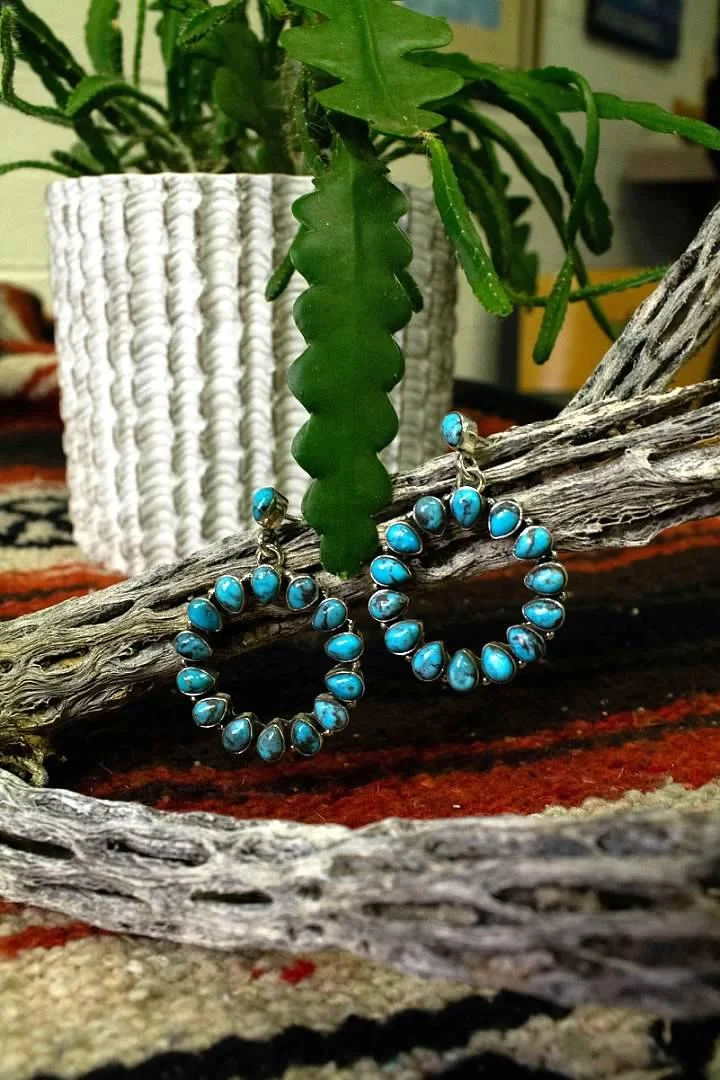
The one question to ask
"Is this natural or stabilized?" Ask it at any counter that sells turquoise. A shop that knows its stone answers without blinking, because every piece in the case was bought with that answer attached. A shop that hesitates, or says "it's all real," or changes the subject to how pretty it is, doesn't know — or doesn't want to say.
We get asked it every week, and we like being asked. It means the customer has done some reading. This is the reading.
What "natural" means
Natural turquoise came out of the ground hard enough to cut, polish, and wear without any treatment. No resin, no wax, no dye, no heat. The color you see is the color the mine made.
That's rarer than people think. Turquoise forms in the weathered upper zones of copper deposits, and most of it comes out chalky and soft. Only a small share of any mine's output is hard enough to use as-is — and that share is what collectors mean when they say "high grade" or "gem grade." At Kingman, which produces more turquoise than any other mine in the country, the natural fraction is still a minority of what's cut.
What stabilization is — and isn't
Stabilizing takes soft, porous turquoise and impregnates it with a clear resin under pressure. The resin fills the pores and hardens the stone so it can be cut into cabochons and worn without crumbling or absorbing skin oil. Done properly, the stone's own color and matrix are unchanged; it's just harder and a little glossier.
That's it. Stabilized turquoise is real turquoise. It's not a fake, and it's not "enhanced" in any misleading sense. It's the process that makes most of the world's turquoise wearable at all. The large majority of Kingman on the market — including a lot of what's in our own cases — is stabilized, and we say so on every piece.
What stabilization is not:
- Dyed stone. Some stabilization adds color along with the resin. That's a different product and should be sold as "color-enhanced" or "dyed." Ask specifically.
- Reconstituted or "block." Turquoise dust and chips mixed with resin and pressed into a slab. Technically contains turquoise; is not a stone. We don't carry it.
- Howlite or magnesite. Different white minerals dyed blue. Not turquoise at all. This is what most cheap "turquoise" is. Our real vs fake guide covers how to spot it.
How to tell them apart
Honestly: on a finished, polished cabochon, you usually can't by eye. Anyone who tells you they can call every stone from across the room is guessing. What you can look for:
- Surface. Stabilized stone often has a slightly glassy, plastic-smooth polish. Natural stone polishes bright but can look a shade more "mineral."
- Uniformity. Very even color across a stone and across a whole tray of matched stones leans stabilized. Natural stone varies.
- Feel. Natural turquoise is slightly porous and will take on a little skin oil over years, deepening the color. Stabilized won't.
- Price. The strongest tell. If a "natural high-grade Kingman" ring is priced like a stabilized one, one of those words is wrong.
- The seller. Ask. Then ask where it was mined. A real shop answers both.
Bring a piece into the shop and we'll tell you what we think it is, free. We'll also tell you when we're not sure, because on some stones you'd need a lab.
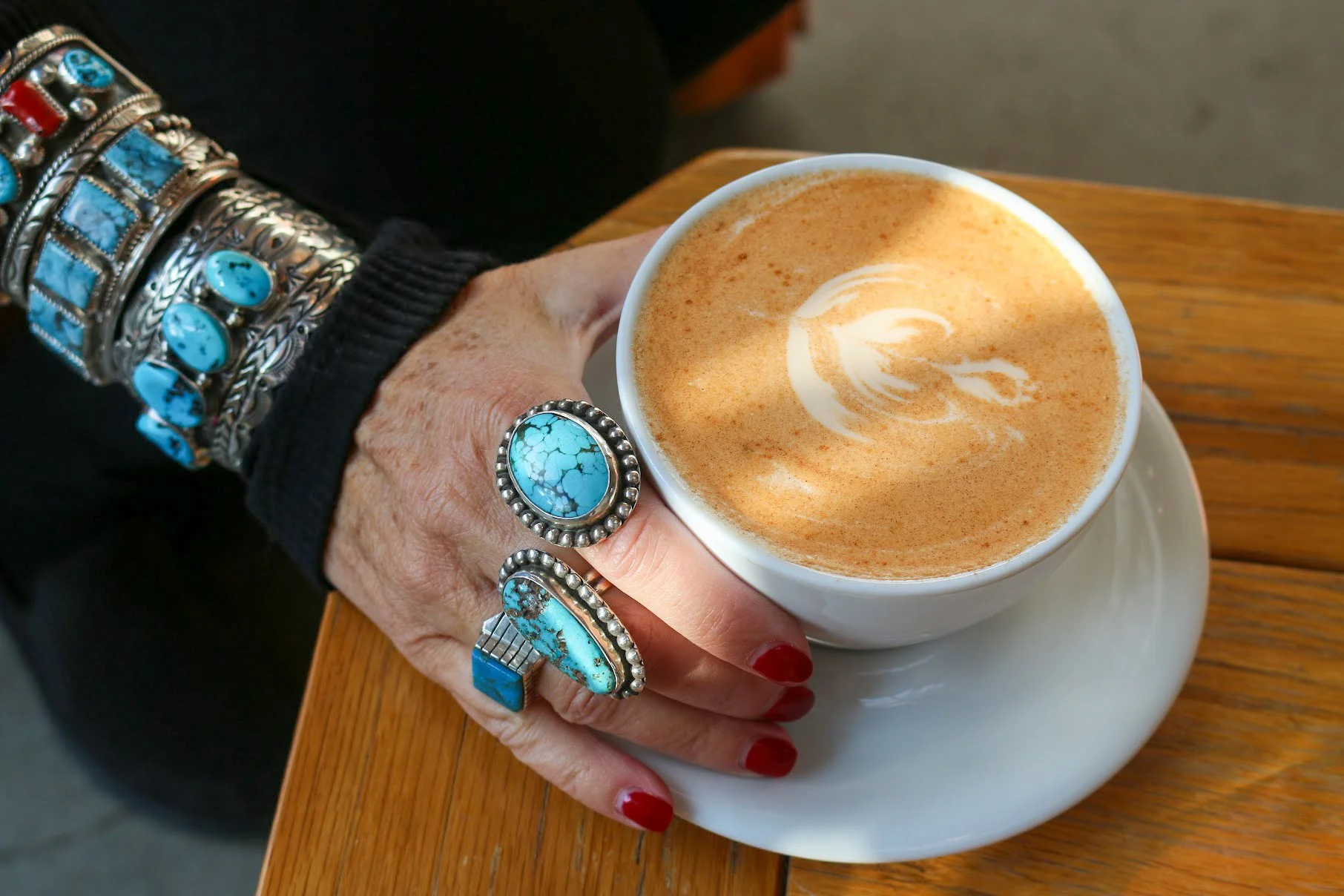
Why the price difference is real
Natural stone is scarce, and a natural stone with good color and tight matrix is scarcer. That's the whole reason. When a cutter opens a bag of rough from the mine, the hard, clean pieces go one direction and the rest goes to the stabilizer. Two cabochons the same size and the same blue can be a few dollars apart in material cost or a few hundred, depending on which pile they came from.
In finished jewelry the stone is only part of the price — silver weight, the silversmith's time, and a signature all count — but it's the part that varies most. So in our cases, a natural Kingman stone is priced above a stabilized one of the same look, and the tag says which is which. If a shop prices them the same, they either don't know or they're charging natural money for stabilized stone.
Which one should you buy?
Depends on what you're doing with it.
- A ring you'll wear every day, on a working hand: stabilized is the practical choice. It shrugs off lotion, sweat, and dishwater better than natural stone. You'll get decades out of it.
- A pendant, earrings, or a ring you take off for chores: either. Natural stone will slowly deepen in color as it picks up skin oil; some people love that.
- A collector piece, or something you want to hold value: natural. That's what the market pays for and what an appraiser wants to see.
- A budget: stabilized gets you real Kingman turquoise, a real silversmith, and a real signature for a lot less. There's no shame in it. Most of the Southwest is wearing stabilized stone.
The only wrong answer is buying one while being told it's the other.
The matrix names you'll hear
Matrix is the host rock left in the stone — the veining. Kingman is known for black matrix, sometimes with pyrite that flashes gold or silver. Collectors have names for the patterns, and they affect price on natural and stabilized stone alike:
- Spiderweb. Fine, dense, connected veining across the whole face. The most sought-after pattern in any turquoise; on Kingman it's black web over bright blue.
- Water web. A Kingman-specific look — a thin, fluid, almost translucent web that seems to float just under the surface. Rare and priced accordingly.
- Birdseye. Small rounded nodules of blue ringed by matrix, so the surface looks like a cluster of eyes. Very Kingman.
- Clean / no matrix. Solid blue, no veining. Valued for a different reason — it's the classic "Kingman blue" — and easier to match across a set of stones.
If a seller tells you chocolate-brown web is the Kingman signature, that's Bisbee's tell. Kingman's is black and pyrite.
See the difference in person
We keep natural and stabilized Kingman in the same cases, tagged, so you can put them side by side under the same light. That's worth more than any guide. We're at 407 E Beale St in downtown Kingman, Monday through Saturday, 11 to 5 — or call (928) 263-1502.
Related reading
- About Kingman turquoise — the mine, the look, the grades
- How to tell real turquoise from howlite, magnesite, and block
- How to care for turquoise so it lasts decades
- Where to buy turquoise in Kingman, AZ
Browse the collections
Rings, necklaces and pendants, bracelets and cuffs, earrings, or Indigenous artisan pieces.
Find your piece. Cherish it for generations.
Stop by the shop on Beale Street, give us a call, or plan a Route 66 detour. We're here Monday through Saturday — no pressure, just honest advice.