Buyer's Guide
The squash blossom necklace, explained.
Where the design came from, what the naja is, how to tell a real one from a reproduction, and what a good one costs. Written by people who keep a case of them in the back.
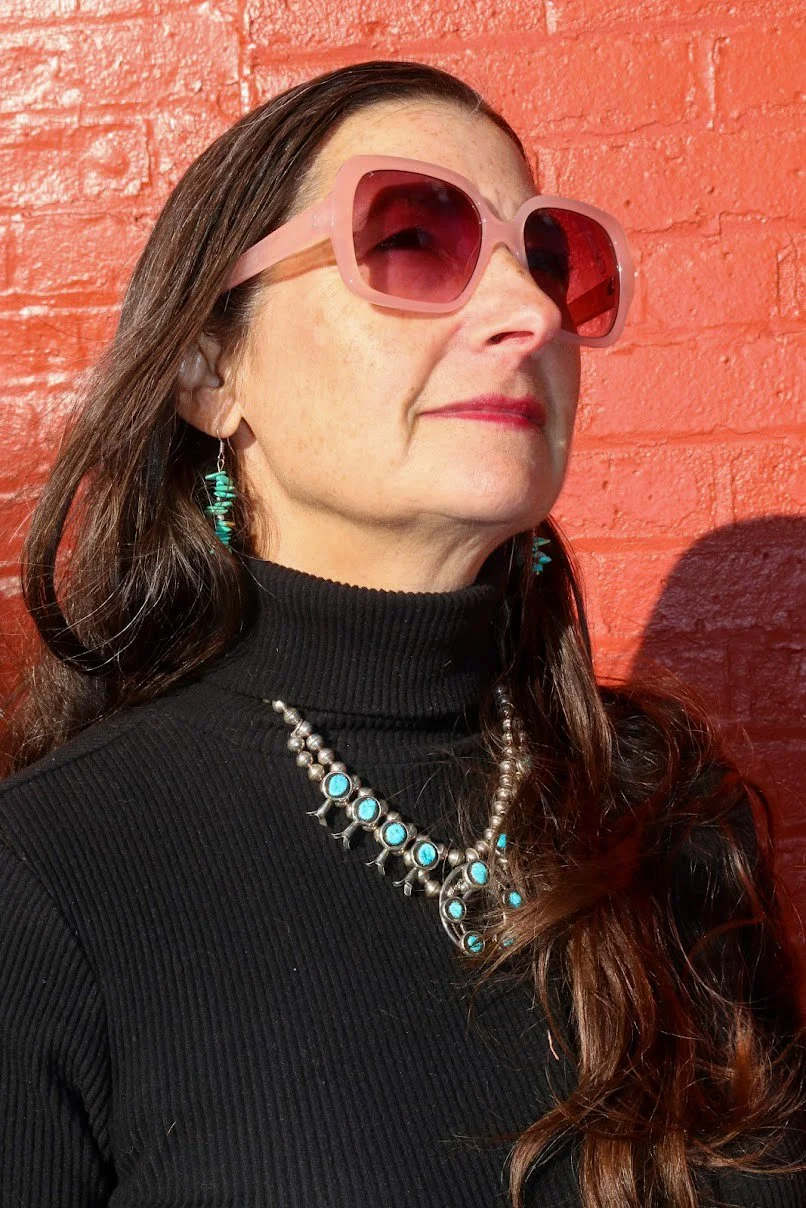
What it is
Three parts. A strand of round silver beads. A set of "blossom" beads spaced along it — a round bead with a flared, petaled tube coming off it. And at the bottom, a crescent pendant called the naja. Most are set with turquoise: in the naja, in the blossoms, sometimes both. Heavy ones run well over a pound of silver.
It's the most recognizable piece in Southwestern jewelry. If someone pictures "Native American necklace," this is what they see.
Where the design came from
Navajo silversmiths started making them in the late 1800s, not long after they learned silverwork from Mexican plateros. Both of the distinctive parts have older roots.
The naja's crescent shows up on Spanish horse bridles, which carried it from Moorish Spain, where it was a protective ornament with roots older still in the Mediterranean and Middle East. Navajo smiths saw it on Spanish and Mexican tack and made it their own.
The "squash blossom" bead is most often traced to the pomegranate — a motif on Spanish colonial clothing and buttons — rather than an actual squash. The name stuck anyway. Zuni smiths later developed their own versions, often with finer stonework and clusters.
We keep the history hedged on purpose. There are confident versions of this story on the internet that go well past what anyone can document. The short, honest version is above.
What it means — and what it doesn't
You'll read that the naja protects against the evil eye, that the blossoms symbolize fertility, that the whole piece is sacred. Some of that has real history behind it; some is gift-shop copy. The silversmiths we buy from mostly talk about it as a form — a design with a lineage they're proud of — rather than a religious object. When a maker tells us a piece carries specific meaning for them, we pass that along with the piece. When they don't, we don't invent it.
How to tell a real one
Reproductions are everywhere, from decent plated pieces to outright junk. Five checks, in order:
- Turn the naja over. A hallmark or signature stamped or engraved on the back is standard for Native-made work from the mid-20th century on. No mark isn't automatically fake — older pieces often weren't signed — but on a modern piece it's a question the seller should be able to answer.
- Check the silver. It should be stamped sterling (or, on older pieces, made from coin silver, which is its own tell). Pick it up. Real ones are heavy. A lightweight piece is plated or hollow.
- Look at the beads. Hand-made beads are two soldered halves with a visible seam and slight variation bead to bead. Machine beads are perfectly uniform.
- Ask about the stone. Natural or stabilized? Which mine? A real shop knows. Dyed howlite in a squash blossom is common in tourist shops — our real vs fake guide covers how to spot it.
- Get it in writing. A receipt naming the silversmith and describing the stone is normal for authenticated work. If a seller won't put it on paper, that's your answer.
What they cost and why
In our case, squash blossoms start around $850 and go up into the thousands. What moves the price:
- Silver weight. The single biggest factor. A heavy piece has a lot of metal in it before anyone's labor is counted.
- Stone. Natural high-grade turquoise with tight matrix costs many times what stabilized stone does. Here's why.
- The maker. A signed piece from a known silversmith carries a premium, and it should — that's decades of skill.
- Age and condition. Older pieces in good condition are collected. Older pieces with replaced stones or repaired beads are worth less, and an honest seller says so.
Anything under a few hundred dollars labeled "squash blossom" is plated, lightweight, set with dyed stone, or all three.
Vintage, "old pawn," and what the words mean
Old pawn is a collector term for pieces — usually pre-1950s Navajo or Zuni — that were originally pawned at reservation trading posts, where families used jewelry as a way to hold and access wealth. Dead pawn means a piece that wasn't redeemed and was sold by the trader. The terms get thrown around loosely now; a lot of what's sold as "old pawn" is just old.
We're a jewelry store, not a pawn shop. When we have older pieces, they come to us on trade or from estates. We'll tell you what we know about a piece's age and history and won't dress it up with words we can't back. If you're specifically hunting older work, call ahead — it doesn't stay in the case long.
Wearing one
A full squash blossom is a statement, and a heavy one. Most people wear it for occasions rather than daily. Silver tarnishes; turquoise hates lotion and perfume. Put it on last, take it off first, and store it flat in its own pouch. Our care guide has the rest.
See ours
We keep the squash blossoms in their own case at the back of the shop and don't put every one out on the floor. If you've been looking for a real one, ask for that case specifically. We're at 407 E Beale St in downtown Kingman, Monday through Saturday, 11 to 5 — or call (928) 263-1502 and we'll tell you what's in it right now.
Related reading
Find your piece. Cherish it for generations.
Stop by the shop on Beale Street, give us a call, or plan a Route 66 detour. We're here Monday through Saturday — no pressure, just honest advice.